
Une étude s’est récemment intéressée aux facteurs ayant guidé le choix d’études des futurs professionnels de la traduction. Il en ressort que même si la majorité des étudiants affirment ne pas avoir aujourd’hui d’idée précise du métier qu’ils exerceront demain, ils restent convaincus qu’ils n’auront aucun mal à trouver un emploi. De par leur transversalité, les compétences linguistiques restent en effet garantes d’une bonne employabilité. Autre fait marquant, l’étude révèle que la « menace » de l’intelligence artificielle n’est pas un élément susceptible de saper leur motivation à travailler dans ce secteur. 88 % des répondants indiquent ainsi que l’IA n’a pas été un facteur d’influence dans leur choix d’études. Les dernières évolutions fulgurantes des moteurs de traduction automatique et des agents conversationnels n’y changent rien : pratiquement aucun n’a envisagé de choisir une autre orientation, et tous demeurent convaincus qu’une formation universitaire longue conserve toute sa pertinence.
Au risque de verser dans le calembour facile, la nouvelle étude menée en décembre 2023 auprès des étudiants de la Faculté de Traduction et d’Interprétation (FTI-EII) de l’université de Mons est riche… d’enseignements. Fondée sur un formulaire envoyé aux 773 étudiants inscrits en 2023-2024, de la première bachelier à la deuxième master, elle se penchait sur l’importance des facteurs ayant guidé leur choix d’études. Une attention particulière était accordée à l’influence de l’intelligence artificielle – sujet brûlant s’il en est.
267 étudiants – soit un taux de participation de 35 % – ont accepté d’allouer 6 minutes et 52 secondes de leur temps (en moyenne) pour répondre aux 24 questions de l’enquête. Organisée sur la plateforme SurveyMonkey et validée au préalable par la direction de la faculté, l’enquête avait été envoyée par l’outil de communication officiel de l’université.
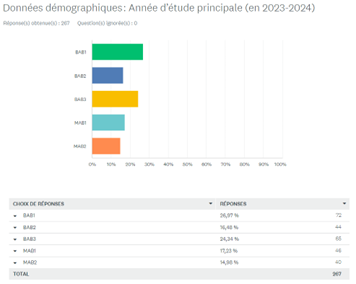
Les étudiants de tous les niveaux ont contribué à l’enquête, avec une dégressivité « logique » au fil des ans, conformément au nombre d’inscrits dans chaque année. À noter toutefois que comparativement, les étudiants des dernières années enregistrent un taux de participation près de deux fois supérieur à celui de la première année (42 % des MAB2 ont pris part à l’enquête [40 sur 95], contre 23 % des BAC1 [72 sur 309]). Au passage, cette observation pourrait indiquer que les étudiants plus avancés dans leurs études – et donc plus engagés dans leur discipline – sont plus enclins à participer, car ils saisissent mieux l'importance de la recherche et s’intéressent davantage à la question de leur insertion professionnelle, mais nous nous garderons de tirer des conclusions hâtives à ce sujet.
Facteurs « généraux »
Comme d’autres l’ont constaté avant nous, la question du processus d’orientation dans l’enseignement supérieur reste multidimensionnelle et complexe. Avec le support de travaux précédents, nous avons décidé de nous concentrer dans la première partie du questionnaire sur quatre facteurs de décision récurrents dans le choix d’études : l’employabilité et le nombre de débouchés associés au diplôme (1), la passion pour les langues et les cultures étrangères (2), l’intérêt général de la formation (3), la réputation de la faculté et le prestige de la profession (4). Plusieurs enseignements peuvent être tirés des réponses obtenues.
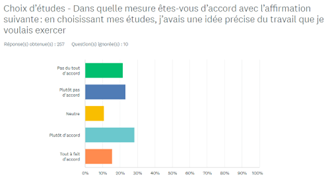
Tout d’abord, on constate que deux tiers des répondants (66 %) n’ont pas d’idée précise de la profession qu’ils comptent exercer en s’engageant dans ces études. On peut attribuer – du moins partiellement – ce résultat au fait que les formations en sciences humaines sont moins professionnalisantes que des formations plus techniques ou liées aux sciences dites dures, comme la médecine ou l’ingénierie. Elles visent avant tout l’acquisition d’un esprit critique et de compétences universelles, mobilisables dans un grand nombre de domaines ou de professions. L’inscription en sciences humaines à l’université marque en premier lieu la volonté des étudiants d’acquérir la « connaissance pour la connaissance », sans avoir de projet professionnel clairement défini. Il apparaît que le domaine spécifique des langues étrangères se prête particulièrement bien à cet objectif d’acquisition de compétences « universelles », ce que vient renforcer encore la diversification des programmes de la FTI-EII, qui offre, en plus des maîtrises « classiques » en traduction et en interprétation, des filières consacrées à la communication multilingue au sens large (diplomatie, entreprises) et à la didactique des langues étrangères.
La question suivante, sur la diversité des débouchés professionnels, vient confirmer cette analyse, puisque 71 % des répondants ont indiqué que cette diversité avait été déterminante dans leur choix d’études. En ligne directe avec les données précédentes, 82 % des répondants mentionnent que l’intérêt des études a été un facteur décisif (nous le verrons plus loin de façon encore plus évidente), et 71 % citent la réputation de l’école, connue pour la qualité de ses diplômes.
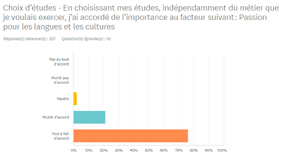
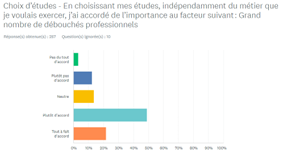
Comparaison passion/raison dans le choix d’études
Indépendamment des facteurs attribuables à la raison, la passion pour les langues et les cultures étrangères est – de très loin – un élément crucial. Ce constat n’est pas vraiment surprenant, mais n’en reste pas moins digne d’intérêt : 98 % des étudiants pointent ce facteur d’influence comme déterminant dans leur décision.
Bien entendu, le contraire aurait étonné, feront à juste titre remarquer les observateurs. Rappelons-leur néanmoins que le facteur « passion » n’est pas aussi évident ou déterminant dans tous les domaines d’études. En effet, comme l’indiquent surtout les nombreux travaux statistiques menés par Sylvie Lemaire en France, dans les filières plus professionnalisantes (telles l’informatique ou l’ingénierie), les débouchés ont une importance largement majoritaire par rapport à l’intérêt de la formation. Nous pourrions même parler de paradigmes opposés. Ces résultats confirment ceux d’études réalisées précédemment – citons celles conduites par l’Observatoire de la vie étudiante de l’université de Genève – ou publiées dans des ouvrages de référence.
Précisons à ce titre que l’étude en question concerne des étudiants en Belgique (francophone), où les admissions en études supérieures ne sont pas conditionnées par les résultats obtenus au baccalauréat (ou CESS en Belgique, pour certificat de l’enseignement secondaire supérieur [CESS]), ou à un concours ou examen d’entrée. Toute comparaison avec d’autres systèmes, notamment français, doit dès lors se faire avec précaution.
La combinaison linguistique : indicateur déterminant ?
L’enquête a ensuite porté sur le choix des langues. Pour rappel, en Belgique francophone, les études de traduction s’articulent autour d’une combinaison linguistique de deux langues sources. L’espace qui nous est réservé ici ne nous permettant pas d’examiner en détail cet aspect, nous nous limiterons à quelques grandes tendances, qui corroborent le rapport précédemment illustré entre raison et passion.
L’analyse du choix des langues confirme ainsi l’existence de trois catégories qui font écho aux études précitées, avec (1) certaines choisies principalement pour leur désirabilité professionnelle (débouchés, pénurie de profils sur le marché de l’emploi), comme l’allemand ou le néerlandais, (2) certaines choisies surtout par intérêt ou passion pour la langue et la culture, sans que les débouchés soient un paramètre déterminant, comme le danois ou l’italien, et (3) une catégorie intermédiaire où l’on observe une répartition presque égale entre ces deux facteurs, comme l’arabe, le chinois, le russe, l’anglais ou l’espagnol.
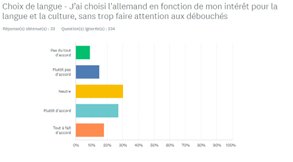
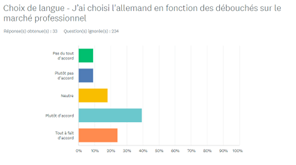
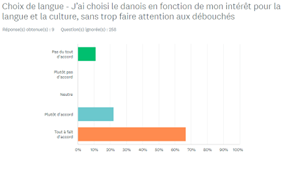
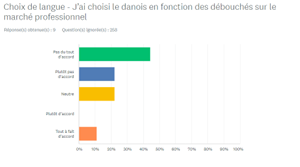
Comparaison passion/raison entre l’allemand et le danois
Intelligence artificielle
Abordons à présent le sujet brûlant : l’IA et, dans notre cas, son influence sur le choix d’études.
Les étudiants en traduction ne semblent pas s’inquiéter de l’influence qu’ont – ou que pourraient avoir – les dernières évolutions technologiques sur leur future carrière. Ainsi, seuls 11 % des étudiants disent être plutôt d’accord ou tout à fait d’accord avec l’affirmation suivante : « L’essor de l’IA a failli m’orienter vers d’autres études. »
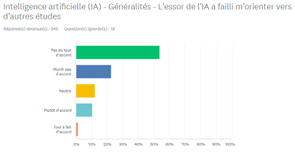
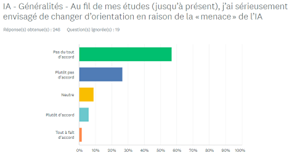
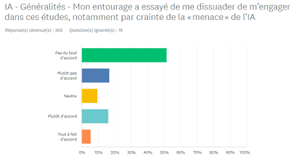
Influence de l’IA sur le choix d’études
Comme l’ont démontré (parmi d’autres) Bourdieu et Passeron, notamment dans Les Héritiers (1964), le phénomène d’« héritage professionnel » illustre l’influence que peuvent avoir les parents et l’environnement familial sur les études que choisissent leurs enfants. Nous avons conscience que la question comprend des dimensions (en particulier sociologiques) bien plus larges, mais les auteurs de l’étude ont néanmoins jugé intéressant d’interroger les étudiants sur ce point, à travers le spectre de l’intelligence artificielle. Même constat que précédemment : compte tenu du « buzz » médiatique de l’IA, nous aurions pu nous attendre à davantage de « tentatives de découragement » de la part des proches. Par ailleurs, le phénomène aurait pu être amplifié par le fait que les médias se plaisent à présenter la traduction comme un métier en voie de disparition depuis des années (exemple ici, ici et ici). Pourtant, seuls 21 % des étudiants révèlent que leur entourage a essayé de les dissuader de s’engager dans cette voie.
Même constat, encore plus marqué, à la question suivante : « Au fil de mes études (jusqu’à présent), j’ai sérieusement envisagé de changer d’orientation en raison de la “menace” de l’IA. » Ici, seuls 8 % des répondants indiquent être d’accord avec cette proposition.
Confiants en l’avenir
La confiance en l’avenir qui se dégage des résultats précédents se confirme dans la certitude de ces futurs diplômés quant à leur capacité à trouver un emploi demain. On observe toutefois un « degré d’inquiétude » de 45 sur une échelle de 100 pour les métiers spécifiques de la traduction et de l’interprétation, mais qui s’effrite rapidement à mesure que le spectre de débouchés s’élargit : l’inquiétude tombe à 31 pour les métiers langagiers et de la communication au sens large, et à 15 seulement pour l’enseignement des langues étrangères.
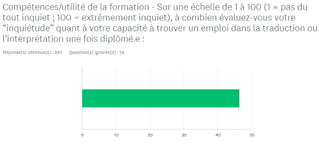
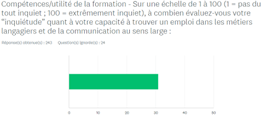
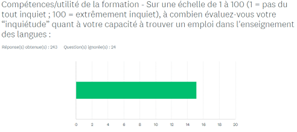
Degré d’inquiétude quant à l’employabilité, par catégorie de débouchés
Compte tenu de la montée en puissance des formations courtes dites « certifiantes », de type webinaire (dans le monde de la traduction francophone, citons par exemple le notoire organisme Edvenn), les auteurs de l’étude ont également jugé utile de sonder les étudiants sur la pertinence des maîtrises universitaires en deux ans.
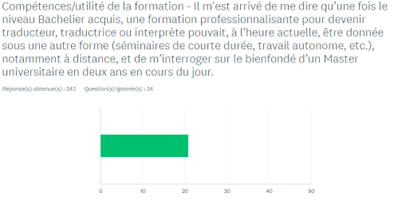
Le taux d’adhésion moyen à l’affirmation s’élève à 21 %, ce qui indique que les étudiants gardent majoritairement foi en leur formation universitaire. Afin d’avoir une idée plus objective, il serait intéressant de poser la même question aux professionnels de la traduction qui ne sont pas passés par un cursus universitaire (formés, par exemple, chez Edvenn). On pourrait supposer une proportion inverse, en partant du postulat que, quel que soit le type de formation choisie, les apprenants ont tendance à se convaincre d’avoir emprunté la bonne voie, et donc à « défendre » leur choix. Par ailleurs, dans la mesure où ils ne connaissent pas l’autre formule, ils ne peuvent pas vraiment comparer… Matière à réflexion pour une prochaine étude !
Et donc ?
L’étude permet de dégager les conclusions suivantes : il convient de se garder d’extrapoler trop facilement les résultats de cette enquête à l’ensemble des étudiants, car comme nous l’avons mentionné, les formations universitaires peuvent fortement varier, allant des plus académiques aux plus professionnalisantes. Des enquêtes menées auprès d’étudiants d’autres universités seraient utiles afin de confirmer – ou d’infirmer – les observations présentées ici.
Le premier enseignement à tirer est que les étudiants inscrits à la FTI-EII de l’université de Mons n’ont en majorité pas d’idée précise (voire pas d’idée du tout) du métier qu’ils exerceront plus tard, ce qui peut paraître étonnant de prime abord, mais qui reflète les tendances déjà observées dans les sciences humaines et sociales, où les compétences (linguistiques) acquises sont « universellement » mobilisables. Lorsqu’on les interroge sur leur employabilité, les étudiants ne craignent d’ailleurs aucunement de se retrouver sans emploi, grâce, entre autres, à la grande diversité de débouchés qui s’offre à eux. On remarque tout de même une baisse de cet indice de confiance à mesure que le métier se spécialise : ils pensent avoir plus de chances de trouver un emploi dans l’enseignement des langues et dans les métiers de la communication au sens large que dans la traduction et l’interprétation.
L’étude indique également que la passion pour les langues et les cultures reste la raison principale pour laquelle les étudiants optent pour cette voie, bien loin devant les débouchés professionnels. Ce résultat s’inscrit dans la lignée des autres réponses aux questions de l’enquête et confirme aussi ceux d’études menées précédemment, notamment en France. Néanmoins, des nuances, parfois importantes, sont observées en fonction de la combinaison linguistique choisie, puisque des langues comme le néerlandais ou l’allemand sont plutôt sélectionnées par pragmatisme (selon les débouchés et les besoins du marché), pendant que l’italien ou le danois le sont presque exclusivement pour une question d’« affects », sans vraiment connaître les débouchés – même s’ils existent.
Enfin, l’intelligence artificielle et sa montée en puissance – en particulier en 2023, avec l’essor fulgurant des agents conversationnels de type ChatGPT – ne semblent ni décourager les étudiants (et leur entourage) à étudier la traduction ou les langues étrangères ni remettre en question le bien-fondé de cette formation universitaire de type long.
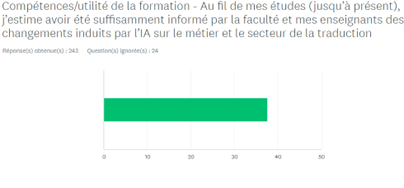
Pour conclure et ouvrir la voie à d’autres études et réflexions, mentionnons encore les résultats de la dernière question : « Au fil de mes études (jusqu’à présent), j’estime avoir été suffisamment informé par la faculté et mes enseignants des changements induits par l’IA sur le métier et le secteur de la traduction. » À cette question, le degré d’adhésion s’élève à (seulement ?) 38, ce qui pourrait laisser penser que de nombreux futurs diplômés se disent d’un côté extrêmement confiants quant à leur employabilité, tout en admettant parallèlement ne pas être assez informés pour l’affirmer avec certitude. Outre la contradiction qu’elle porte en elle, cette observation implique sans doute aussi une remise en question de la part du corps professoral – en partant du postulat qu’il soit mieux averti, ce qui reste à démontrer, tant la rapidité des évolutions favorise l’instabilité et complique les conjectures. À ce titre, le commentaire ajouté par l’un des répondants à l’enquête résume bien la situation : « De quoi demain sera-t-il fait ? L’avenir nous le dira ! »
Pour consulter les résultats complets de l’enquête, cliquez sur ce lien.
Détails
- Date de publication
- 12 mars 2024
- Auteur
- Direction générale de la traduction
- Langue
- français
- italien
- Catégorie EMT
- Expérience professionnelle/Employabilité
- Compétences en traduction